
 Troubleshooter
Flow type
With the help of Reynold’s number type of flow may be roughly determined.
The type of flow is an important factor when considering energy loss within hydraulic system.
Therefore are two types of flow namely:
- Laminar flow;
- Turbulent flow.
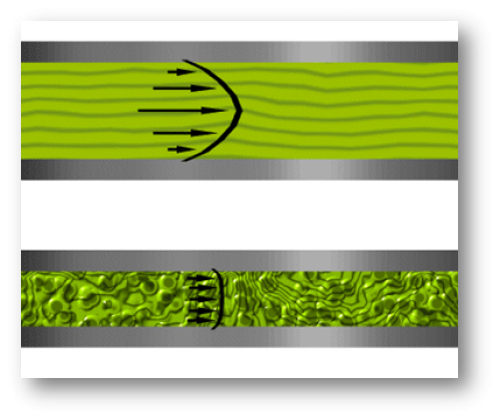
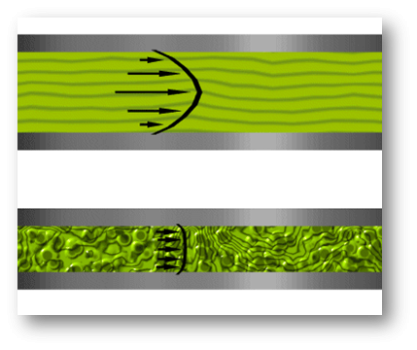
Up to a certain velocity, liquids move along the pipes in layers. If the velocity of flow is increase at the critical point the flow changes and almost spinning around and get turbulent flow.
Hence the flow resistance increases and thus the losses increase. Also the higher flow velocity in a hydraulic system the more heat is generate. Therefore turbulent flow is not desirable.
This is dependent on flow velocity and pipe diameter among other things. The maximum recommended velocity in main lines is 5 meters/second.
Straight pipelines can generate heat due to friction, velocity and resistance. Pipe bends, elbows and other hydraulic fittings can also generate heat when fluid is force to change direction. Depending on the pipe size, one elbow could generate as much heat as several meters of pipe.
The velocity critical point it is also dependent on the viscosity of a liquid.
Reynold’s number
The critical velocity also may be calculated and should not be exceeded in hydraulic circuits. With the help of Reynold’s number note as Re the type of flow may be roughly determine.
In some documentation is mention flow changes from laminar to turbulent between Reynold’s numbers 2000 and 4000. Approximately the number it can be calculate more precisely.
Keeping in mind the basis formula: Re =V x dh/v it can be found the Re critical the type of flow changes from laminar to turbulent and reverse. For more explanation let me know.
- Reynold’s number specified the type of flow either laminar or turbulent;
- Turbulent flow in a hydraulic system should be avoided;
- Recommended velocity value in main lines is 5 meter/second;
- One elbow may generate heat as several straight meters of pipe.
The post is fill under Hydraulic Basic Chapter/Tab






Interesting and useful information about Reynold’s number
I read it the post up and I found it interesting and very useful information. In some cases in my experience so far I come across to this Reynold’s number especially for new building projects. When in charge of new building and hydraulics is involved it’s good to know about this aspect hence flow type in an installation. This Re number can influence and determined the type of flow within system. Also another good info I get is the maximum recommended velocity in main lines.
Can you please add the description of each variable, as well as their units of measurement in the formula? Thanks.