
 Troubleshooter
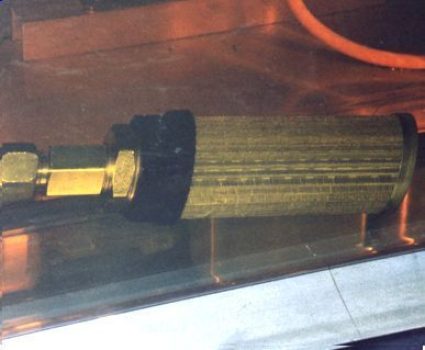
Suction filter
Its function maintains the oil clean by removing large solid particles from the fluid. The suction filter is make of wire mesh screens, which removes significant and large solid particles from a fluid.
Over 70% of hydraulic system failure are due to contamination. Contamination is dirt from the tank and particles caused by wearing out of the components themselves. Properly sized, installed and maintained filters play a key role in the hydraulic system.
Protection of the pump
It is only possible to protect the function of the pump with a suction filter. To protect expensive equipment e.g. variable pumps, the pressure difference at the filter must not be very large. Hence filter with large surfaces are usually installed. In practice a suction filter is 2.5 to 5 times bigger than the pump output, because a sufficient flow through it must be possible, even with a dirty filter, to prevent an excessive loss of pressure across the filter. When a filter is block generates a large pressure loss.
Under normal conditions, permissible pressure difference across a suction filter is 3 PSI.
Two types of suction filter are on the market:
- Filter without housing;
- Filter with housing.
Without housing is install in the suction line below the minimum level of oil in the tank.
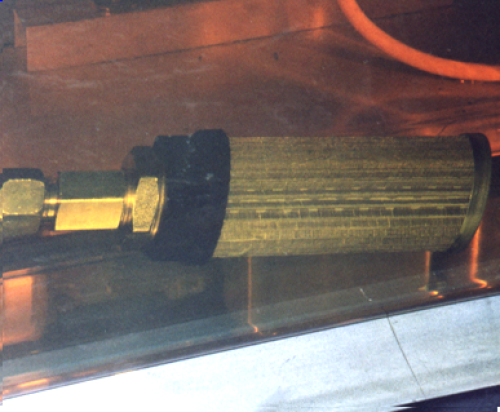
A suction filter with housing may also install below the level of oil in the tank, so that housing is fill with oil and considering is with housing assembly is difficult.
Maintenance an important job to eliminate malfunction in the hydraulic system.
I will summarize the pros and cons of this type of filters:
Pros:
- Price
- The hydraulic pump is protected from tank dirt;
Cons:
- Assembly is difficult, worse position in the hydraulic system
- Are difficult to service because are below fluid level in the tank;
- Bypass is necessary
- Due to risk of cavitation only coarse filtration is possible.
- No warning when is clogged;
Filter type
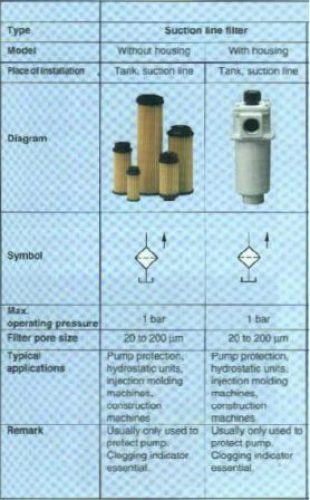
- Removing large solid particles from the fluid;
- Typical application is to protect the pump, heart of the hydraulic system;
- In practice a suction filter is 2.5 to 5 times bigger than the pump output;;
- Pressure difference across filter is 3 PSI.


“A sump strainer/suction filter does more harm than good?”
In the past, when I started with my website, way back in 2011 I open a discussion about: “A sump strainer/suction filter does more harm than good?” which is worth mentioned. This days I was browsing my files and I found it. Therefore below I will add the comments which are very interesting for technical point of view and I would like with this occasion to thank the guys involve for involvement in this topic.
All the best!
Long suction line may be problematic
With gear pumps with a viscous fluid or a long suction line they may be problematic, but when the pump is sensitive to contamination like must variable pumps they are inevitable.
Suction filter highly reduce risks of pump damage from errors in commissioning or reservoir corrosion and etc. I think a good design of suction line can compensate for the pressure drop through the suction filter.
By default a suction filter strainer should not be used
In my opinion a suction filter should be application specific based on the tolerance of the system and what can be sacrificed. If there is enough debris floating around in the tank to clog the suction strainer than a bypass will only further aggravate the issue.
By default a suction strainer should not be used in my opinion.
If you start with clean oil, a clean tank and a clean system and it is maintained properly with pressure and return filtration than suction strainer shouldn’t be required.
Strainer is not the fault, it is the maintenance team
Actually suction filter is not the fault, it is the maintenance team who destroy the system by not maintaining or checking the condition of the filters and strainers. I don’t blame them….it is a difficult job to reach the strainer.
The designer should see that the suction filter strainer is placed in such a location that it is accessible easily.
May be it is not a bad idea to have a strainer with a gauge or some electronic signal which gives out a signal when it is in a condition to be cleaned.
Suction filter strainers wreak more pumps than debris in the system
There is really no good reason for a suction filter strainer. No strainer catches particles small enough to keep a pump from being damaged. Typical strainers are about 100 micron or larger, and even gear pumps can only tolerate particles up to 15 micron without suffering damage in the meantime.
If your get larger debris caught up in a strainer you will quickly cavitation to the pump, which will cause damage and excessive wear on all pumps, especially expensive piston pumps. Deal with the problem by removing the opportunity for debris to enter the reservoir in the first place!
1. Pick a good reservoir and breather assembly with a clean out access plate.
2. Add oil fill fittings so the mechanic fills the reservoir through the return line with an offline pump so that the return line filter can clean the oil as it enters the reservoir.
3. Specify proper procedures for maintenance of the reservoir.
4. If your system is sensitive to contamination add an independent kidney loop filter system to keep the oil clean.
5. If necessary, use a charge pump with a medium pressure filter in front of the very expensive or sensitive pumps.
Suction filter strainers wreak more pumps than debris in the system.
A kidney loop filtration system in the tank better than a suction filter
If you are worried about debris in the reservoir it is much better to put a kidney loop filtration system in the tank than a suction strainer.
The kidney loop runs at low pressure and can be set up to run while the machine is down to clean the reservoir after maintenance or after contamination is detected.
The kidney loop can be built into the machine or it can be a portable unit that is attached to the machine and run after maintenance is performed. That way the tank is kept clean and you do not put the main pump at risk from cavitation caused by the suction filter.
Suction filter strainers aren’t required in general hydraulic circuits
I would have to agree that suction strainers aren’t required in general hydraulic circuits (I say general because there are certain exceptions). Suction filter strainers may aggravate pump cavitation and may result in the premature failure of your equipment, more so with piston pumps. This is more common than pump failure due to hard particles being sucked into the pump.
This is implied only if your tank’s return line filters are healthy and there is no debris in the reservoir to begin with. Keeping your system clean and elements running from day one is essential to maintaining the life of your hydraulic elements.
Be careful that external debris does not enter your tank during servicing and/or topping up your oil!!
A good practice to slightly oversize the inlet strainer
When you use a suction filter strainer, it is always a good idea to select one with a bypass in case it does get clogged. Depending on the environment the system is in my opinion, should determine whether or not to use an strainer.
Not to mention the type of pump vs. application. It is always a good idea to perform scheduled preventative maintenance on your equipment. If this is done, chances are, your strainer will be checked and either cleaned or replaced before becoming an issue.
Just remember it is always a good practice to slightly oversize the suction filter to avoid starving the pump.
Regular servicing of hydraulic units
In my experience I regularly find that most hydraulic systems are sadly neglected. Hydraulics have a tendency to be very reliable therefore they become ignored and servicing is not always first on the list, production is, and rightly so.
What I do find is water in tanks because of change in volume and poorly maintained breather systems, rust forming on the base of the tank, underneath the lid and on the sides of the tank.
Under these conditions and assuming that a large enough suction filter was fitted in the first place, which is usually the case, the emulsions and rust tend to be deposited on the bottom of the filter therefore it is achieving its purpose of being fitted.
I agree with the views of others to carry out regular servicing of hydraulic units and promote the use of offline filtering whilst the machine is in operation to ensure infrequent oil returns from parts of the system are also filtered.
No suction filter strainer but about 1″ of mud…
@Ian, sounds like you have visited some of my customers, I work for a Hydraulic service company and a good 90% of the issues we see are caused by lack of maintenance. We have a customer that has a 600 Ton press. When we were called in the rod seals were so badly worn that it would leak gallons of fluid on every stroke.
They were collecting the leakage and pouring back into the reservoir. We were called because the leakage was so bad the cylinder would not stroke. After weld repairing and re-chroming the slug and replacing the chevron packing they were up and running, for about 2 hours.
Then the pump stopped and tripped the motor breaker. We opened the pump and found a piece of wood about 1/2:” in diameter and 4″ long wedged between the gear and the pump housing. When we opened the reservoir we found no suction filter but about 1″ of mud, rust wood chips etc.
Never underestimate the ability of an end user to screw up a system.